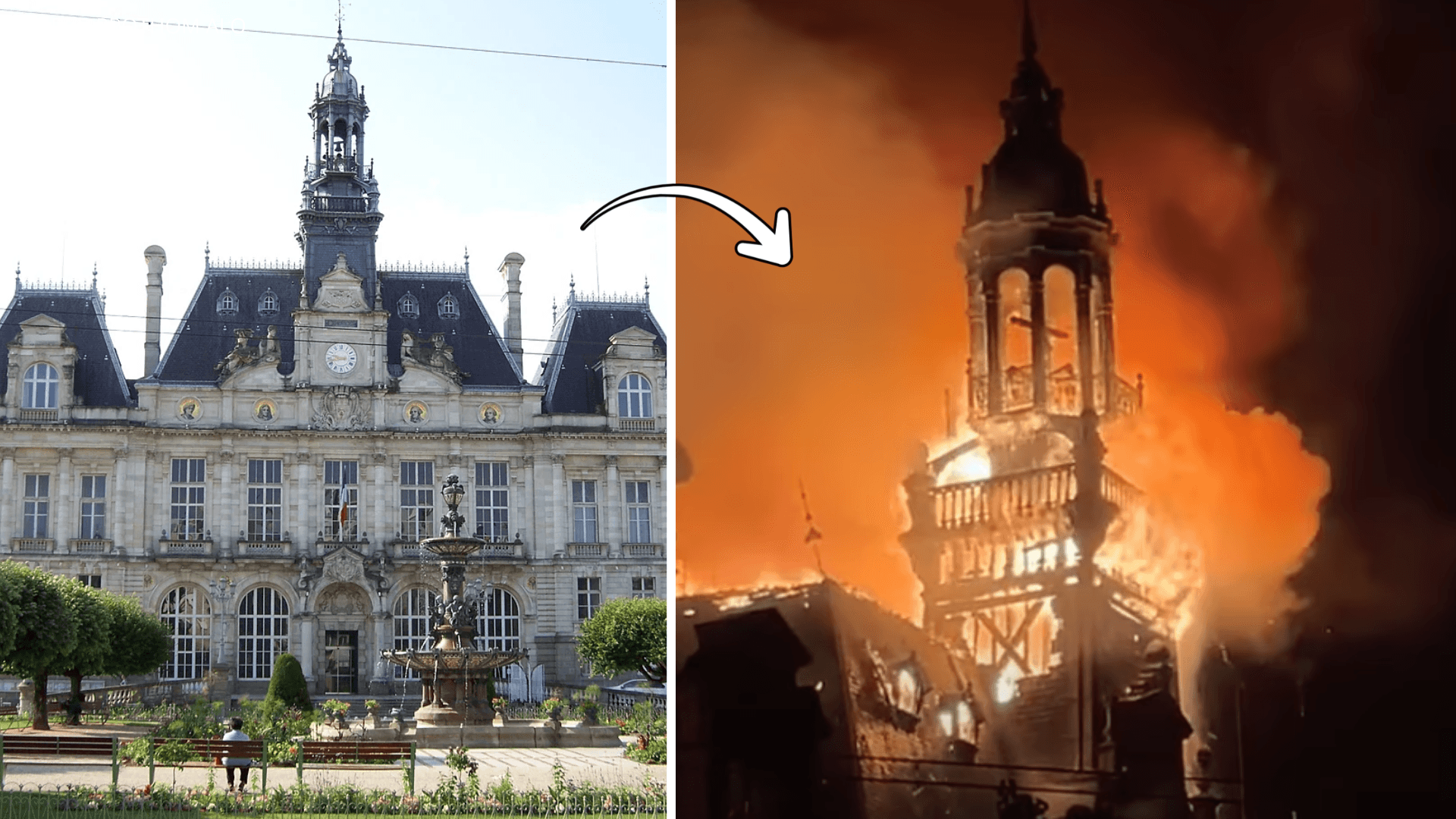
France experienced a day of widespread unrest as protests over the rising cost of living, declining public services, and dissatisfaction with President Emmanuel Macron’s government escalated into violence across several cities. Demonstrations involving students, trade unions, climate activists, and supporters of the Yellow Vest movement resulted in arson, looting, injuries, and more than 1,200 arrests. One of the most significant incidents occurred in Limoges, where a historic town hall was severely damaged by fire.
Historic Town Hall Damaged in Limoges
The 143-year-old Hôtel de Ville, or town hall, in Limoges was engulfed in flames on Saturday night after rioters set the building alight. The fire caused the collapse of its clock tower, destroying an important part of the city’s historic architecture. Videos circulated online showed some protesters cheering as the tower fell. The incident became a powerful symbol of the scale of destruction that accompanied the nationwide demonstrations. Limoges was not the only city affected by the violence. Similar incidents were reported in Paris, Lyon, Marseille, Saint-Étienne, Lille, and Nice. Cars were burned, shops were looted, public buildings were damaged, and clashes between demonstrators and police intensified throughout the day.
According to Prime Minister Sébastien Lecornu, approximately 1,200 people were arrested nationwide, while 150 police officers were injured. He expressed relief that the consequences had not been even more severe and urged citizens to distinguish between defending republican principles and participating in violent disorder. Lecornu also warned that France would not allow violence to intimidate the government or determine the country's political direction.
A Nationwide Movement of Protest
Approximately 550,000 people participated in the demonstrations, including around 110,000 in Paris. The protests brought together a diverse coalition of citizens dissatisfied with the government, including students, workers, trade unions, and supporters of the Yellow Vest movement. The Yellow Vest movement first emerged in 2018, in response to rising living costs and economic pressures. Its renewed presence reflected continuing concerns about affordability, inequality, and the difficulties faced by ordinary households. Trade unions representing teachers, nurses, farmers, and taxi drivers joined the demonstrations, alongside climate activists and other groups demanding political and social change.
What began as student-led protests against teacher shortages and deteriorating school facilities in the suburbs of Paris gradually developed into a broader expression of public frustration. Some schools had reportedly been set on fire during the earlier demonstrations, highlighting the increasingly volatile atmosphere surrounding the movement.
In Paris, thousands of demonstrators marched through the streets, chanting slogans demanding Macron’s resignation and expressing hostility towards the police. At Place de la République, protesters gathered around the statue of Marianne, a national symbol of the French Republic. Two activists climbed the statue and displayed a banner accusing police officers of injuring high-school students. The crowd responded with cheers.
Violence and Clashes in Major Cities
The demonstrations resulted in serious incidents across the country. In Lyon, protesters set fire to a tourism office in a central square. Groups of masked and hooded individuals reportedly threw objects and fireworks at police officers, who responded with tear gas, water cannon, and dispersal grenades.
In Marseille, shops were looted and a police station was damaged. Some demonstrators also briefly entered the lobby of the city hall. In Lille, rioters broke into the town hall, while a man in Nice suffered serious injuries while attempting to smash a shop window.
Saint-Étienne witnessed one of the most disturbing incidents when a protester lost a hand after a police stun grenade exploded. The injury intensified existing concerns about police methods and the use of weapons during demonstrations.
Although President Macron had repeatedly appealed for calm before the weekend, his requests failed to prevent the violence. In response to the destruction, he promised that individuals responsible for vandalism, attacks on public institutions, and looting would face prosecution and punishment. He stressed that damage to public property and businesses would not be tolerated.
Concerns About Police Conduct
The response of law enforcement became a major issue during the protests. Riot police used batons, tear gas, water cannon, and other crowd-control weapons to disperse demonstrators, particularly those throwing fireworks and other objects at officers. However, human rights organisations and protesters criticised what they described as excessive police force. Public anger had already grown following earlier incidents involving minors. At the beginning of the month, police official Mr Nuñez suspended the use of stun grenades after a 15-year-old lost a hand in an incident involving one of the weapons. Another incident reportedly left a 14-year-old with several broken teeth after a tear-gas grenade struck him in the face at close range.
Despite the controversy, Nuñez subsequently reinstated authorisation for stun grenades during Saturday’s demonstrations. He argued that officers needed access to appropriate intermediate weapons when confronting serious and violent clashes. The decision further intensified debate about the balance between maintaining public order and protecting citizens' rights. The account also notes that France is the only European Union country authorising explosive ammunition for law-enforcement operations.
Some demonstrators argued that the government's approach was undermining democratic freedoms. Romy, a protester in her twenties, said that expressing political opinions and demonstrating for rights had become increasingly difficult under Macron's administration. She also raised concerns that police repression disproportionately affected people of colour.
According to Romy, fear of police violence had discouraged some people from attending the demonstrations. Her mother's anxiety about her safety illustrated how tensions between protesters and law enforcement had affected families as well as public life.
Public Services and Economic Frustration
Beyond the immediate violence, the demonstrations reflected deeper concerns about the condition of France's public services. Margaux, a 26-year-old medical resident, attended the Paris protest to support the public healthcare system and provide emergency assistance to fellow demonstrators. She carried saline solution for treating irritation caused by tear gas, along with dressings, gauze, and supplies for burns.
Margaux argued that hospitals were struggling because of declining resources and inadequate funding. She questioned how a wealthy, developed country could remain insufficiently prepared for challenges such as heatwaves while healthcare workers faced worsening conditions.
Other demonstrators expressed similar concerns about deteriorating schools, teacher shortages, and what they viewed as the systematic weakening of public institutions. Eve, who attended the protest with her husband and eight-year-old son, Nil, said her family wanted to support students and public-sector workers. She also condemned the use of force against minors, arguing that peaceful young demonstrators should not be treated as violent threats.
These accounts demonstrated that the unrest was not solely about the cost of living. It also reflected dissatisfaction with public spending, social inequality, policing practices, and the perceived decline of essential services.
Political Reactions and the Road Ahead
The protests also attracted international and domestic political attention. Former US President Donald Trump joked during a rally in Kentucky that a French revolution had begun, referring to the scale of the unrest. Within France, political leaders offered contrasting interpretations of the demonstrations. Marine Le Pen, the prominent far-right politician preparing for the next presidential election, condemned the looting and attacks on police. She argued that violent groups had undermined the original cost-of-living protests and claimed that the far left had diverted attention from legitimate public grievances.
Jean-Luc Mélenchon, a leading figure on the French left, urged police to avoid using weapons capable of causing permanent injuries. He also criticised aggressive tactics involving vehicles and mounted officers moving against crowds.
Prime Minister Lecornu warned that violence would not be permitted to influence the upcoming presidential election. He maintained that political objectives could not be imposed through intimidation or destruction. Macron, meanwhile, called for calm and expressed support for police officers confronting violent demonstrators.
The nationwide unrest exposed serious divisions within French society. Although the demonstrations began with concerns about education, living costs, and declining public services, they developed into a broader confrontation involving political dissatisfaction, police conduct, and public order. The destruction of the historic Limoges town hall illustrated the consequences of the escalating violence, while injuries and mass arrests highlighted the risks faced by demonstrators and law-enforcement officers alike.
As France approaches another presidential election, the protests may serve as an important indicator of public sentiment. The government faces the challenge of restoring order while addressing citizens' concerns about economic hardship, public services, and democratic freedoms. Ultimately, reducing tensions will require not only effective law enforcement but also meaningful engagement with the social and economic grievances that have brought so many people onto the streets.