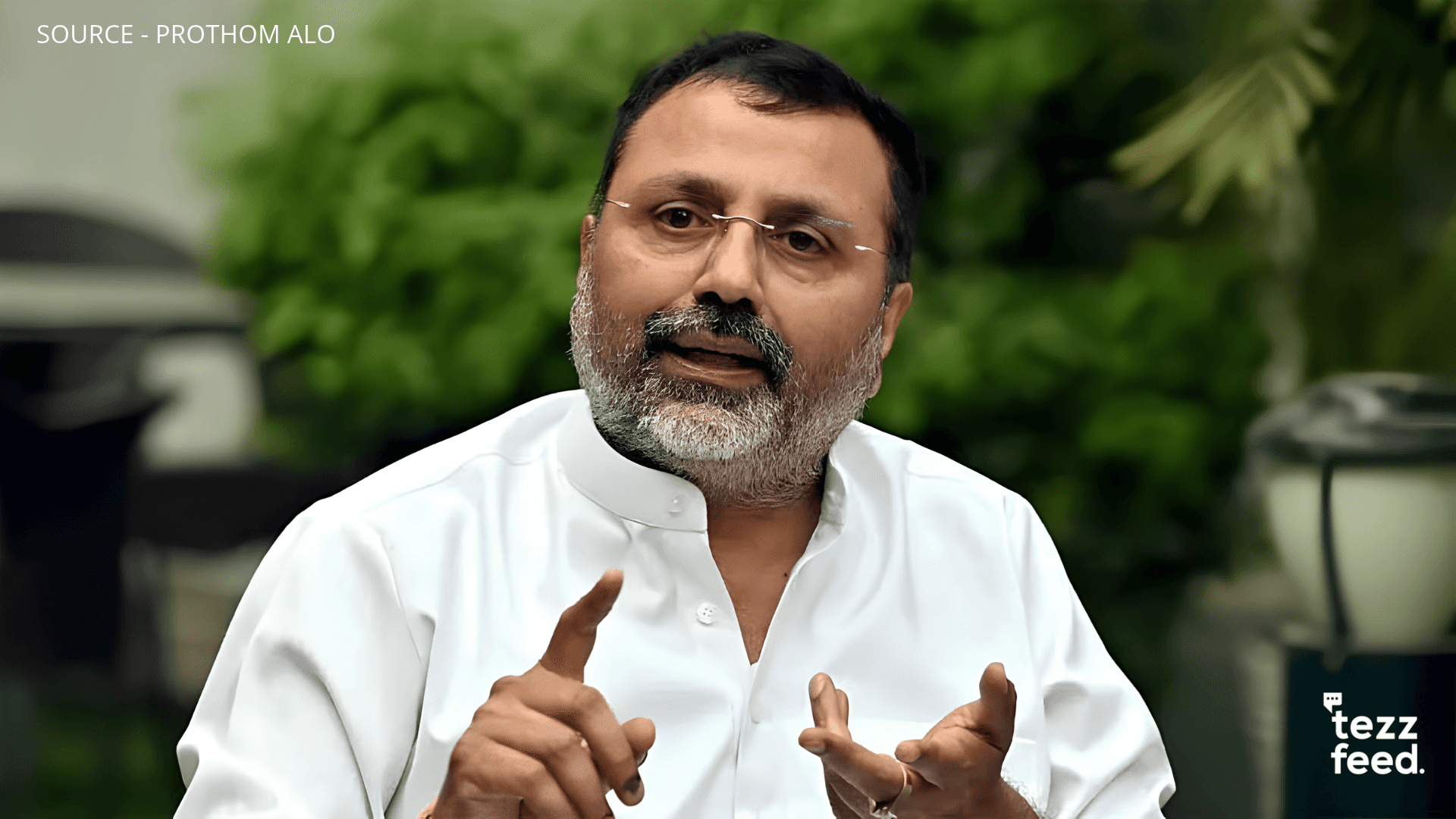
BJP parliamentarian, Nishikant Dubey, has triggered widespread controversy after suggesting that India should seek to reclaim Bangladesh’s Chattogram Port, Noakhali and Sylhet, along with Pakistan-administered Azad Kashmir. In an interview with Indian news agency ANI on Friday (November 6), Dubey alleged that these territories had been “forcibly transferred” during the tenure of former Prime Minister Jawaharlal Nehru.
He further argued that the areas historically formed part of the ancient Tripura kingdom. Taking aim at Nehru over the 1946 communal violence in Noakhali, Nishikant also linked the loss of access to Chattogram Port to the economic and infrastructural backwardness of India’s northeastern states. Portraying the matter as an opportunity to rectify what he considers historical wrongs, he called for India to bring Chattogram Port, Sylhet and Noakhali under its control once again.
His suggestion is not merely provocative but rather reflects a deeply problematic understanding of history, sovereignty and the relationship between two independent neighbouring countries. For Bangladeshis, the issue is straightforward, Chattogram, Noakhali and Sylhet are not lost Indian territories waiting to be reclaimed. They are integral parts of Bangladesh, a sovereign nation whose independence was achieved through a historic struggle in 1971. Suggesting that India should take control of these regions disregards the identity, rights and political will of millions of Bangladeshis.
What makes the remarks particularly offensive is the implication that Bangladesh's territorial integrity is negotiable based on selective interpretations of historical maps. Modern national borders cannot be casually challenged by invoking ancient kingdoms or colonial-era political arrangements. If historical territorial claims were sufficient justification for taking land, virtually every country in South Asia could make competing claims against its neighbours.
The historical argument itself is also questionable. The territories in question did not simply belong to the state of Tripura and then got handed over by Nehru. The partition of British India in 1947 involved complex political negotiations, provincial boundaries and the decisions of local populations. Sylhet was assigned to East Bengal following a referendum held on 6 July 1947, in which the majority voted to join East Bengal. Its fate was therefore not simply a unilateral decision by Nehru. The partition of Bengal and the Radcliffe boundary process must also be understood in their proper historical context.
The attempt to connect the 1946 Noakhali violence with present-day territorial claims is equally misleading. The violence against Hindus in Noakhali was a horrific episode that deserves honest historical recognition and justice. However, the suffering of people in 1946 cannot be used as a justification for threatening the sovereignty of Bangladesh in 2026. Historical tragedies should encourage reconciliation and a commitment to protect minorities, not become political instruments for territorial expansion.
Nishikant's argument about Chattogram Port and the underdevelopment of India's northeastern states is similarly flawed. There is no denying that geographical access to Chattogram could have provided significant economic and logistical advantages to India's Northeast. However, simply because a single port benefits a specific region of their country, does not justify occupation over it. India and Bangladesh can address connectivity challenges through trade agreements, transit arrangements and regional cooperation without questioning each other's borders.
Most importantly, Bangladesh is not an extension of India's historical imagination. It is an independent country, established through the blood and sacrifice of millions of people during the 1971 Liberation War. Its sovereignty is constitutionally recognised, and its territorial integrity is not subject to the political ambitions of an Indian parliamentarian. A responsible political leader should know the difference between discussing historical grievances and making territorial demands against a neighbouring country. Calling for the reclamation of Bangladeshi territory is not an exercise in correcting history, it is an irresponsible statement that risks encouraging hostility, undermining mutual trust and damaging bilateral relations.
India and Bangladesh share deep cultural, linguistic, historical and economic connections. Their future should be built on mutual respect, cooperation and recognition of sovereignty, not on nostalgia for disputed interpretations of pre-partition geography. Bangladesh does not need to justify its existence or defend its ownership of Chattogram, Noakhali and Sylhet. These are Bangladeshi territories and the people who live there are not bargaining pieces in another country's political debate.