
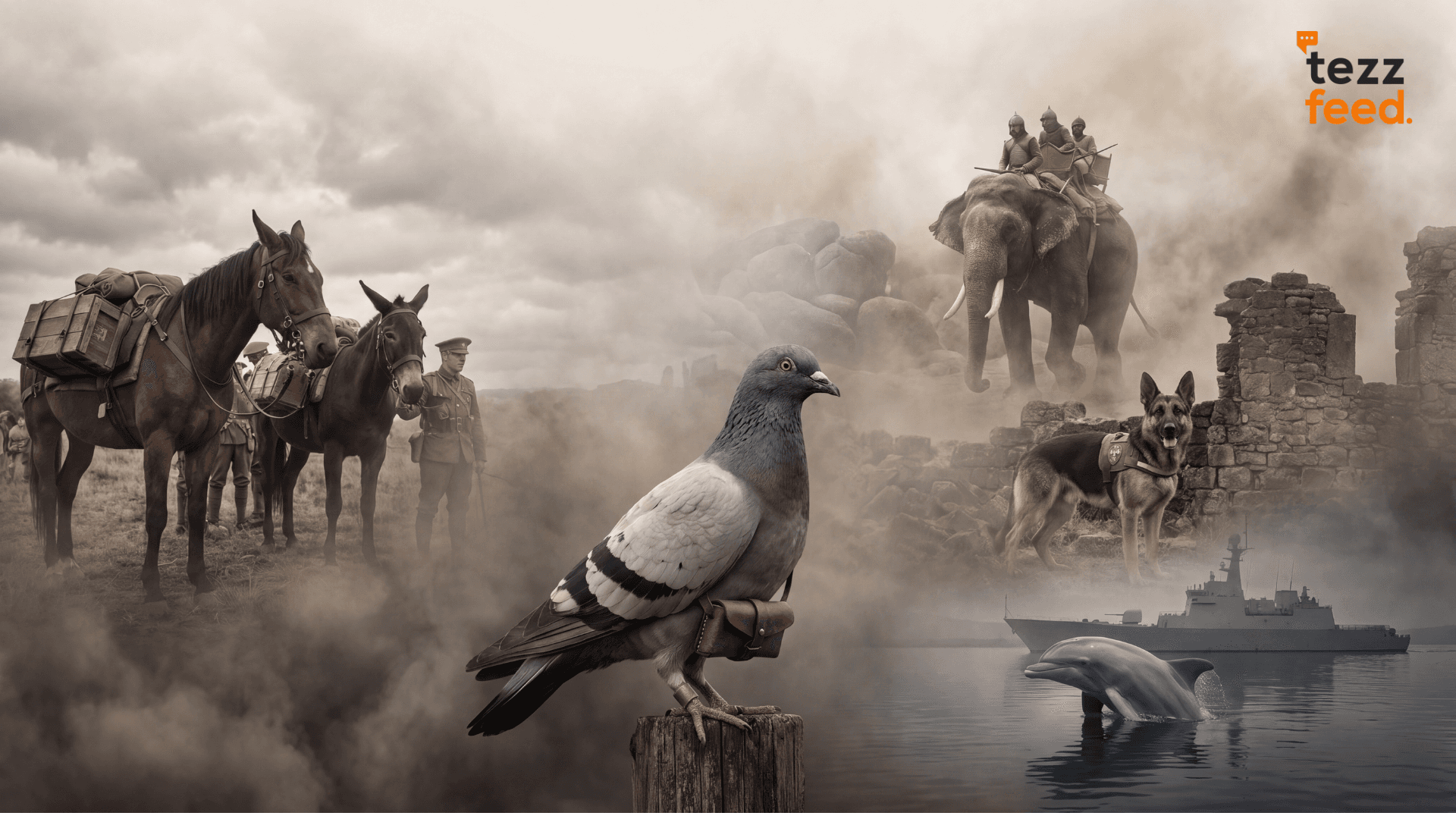
1. Pigeons: The flying messengers
When we imagine war, we usually imagine soldiers in uniforms, tanks rolling across battlefields and fighter jets roaring through the sky but throughout history some of the most important participants in human conflicts had feathers, fur, hooves and even fins.
Before smartphones, satellites and secure military radios, armies had a surprisingly effective communication system by the help of pigeons. During the First World War, telephone wires could be destroyed by artillery fire while human messengers could be killed trying to cross dangerous battlefields. Homing pigeons offered a simple solution by attaching a tiny message to a bird which would then fly back to its home loft.
One of the most famous military pigeons was Cher Ami which was a bird that served with the U.S. Army Signal Corps in France. In October 1918, during the Meuse Argonne Offensive, around 200 American soldiers from what became known as the ‘Lost Battalion’ were trapped behind enemy lines and to make things even worse, American artillery began accidentally firing on their position. Several attempts to send messages failed but then Cher Ami was released.
The pigeon was shot during the flight and suffered severe injuries but somehow it still managed to reach its destination with the message. The artillery fire was redirected, helping save the trapped soldiers. Cher Ami later received the French Croix de Guerre and remains one of the most famous animal figures of the First World War. Pigeons became such an important part of military communication that armies developed entire pigeon services. Their ability to travel through smoke, explosions and difficult terrain made them useful even when more modern technology failed. Imagine being in the middle of one of history's deadliest battles and your emergency communication system is basically a very determined bird!
2. Horses and Mules: The military workhorses
Long before tanks and military trucks existed, armies depended heavily on horses. For centuries, horses carried cavalry soldiers into battle but their role went far beyond dramatic charges with swords and flags. Horses pulled artillery, transported supplies and carried injured soldiers. Mules performed similarly difficult jobs especially in mountainous areas where vehicles struggled to travel. During the First World War, modern weapons were becoming increasingly industrialised but armies still depended enormously on animals. Horses and mules moved food, ammunition and equipment across muddy battlefields where trucks could not always operate effectively.
3. Slugs: The tiny gas detectors
During the First World War even slugs ended up playing an unexpected role. Dr. Paul Bartsch of the U.S. National Museum discovered that slugs could detect mustard gas before humans could. When exposed to the gas, the slugs would close their breathing pores and contract their bodies. Soldiers learned to watch for these reactions and if the slugs showed signs of distress, quickly put on their gas masks. The tiny ‘slug brigade’ became an unlikely early warning system that helped protect soldiers from dangerous levels of mustard gas.
4. Elephant: The ancient war machines
Long before tanks existed, armies created absolute panic by the help of elephants. In ancient India, elephants were an important part of armies for centuries used to break enemy formations and carry commanders and soldiers, clear paths and intimidate opposing troops. Their size alone could terrify soldiers and especially frightened horses.
The idea eventually travelled west and at the Battle of Hydaspes in 326 BCE, King Porus of India used a large elephant force against Alexander the Great. Later, the Carthaginian general Hannibal famously took elephants across the Alps during his invasion of Italy in the Second Punic War. Of the elephants that began the journey only a few survived the brutal crossing. They were impressive but hardly a perfect weapon because a wounded or frightened elephant could panic and trample their own soldier.
5. Dogs: Soldiers’ best friend
Dogs have probably been used in military settings for thousands of years but their roles became especially organised during the world wars. Military dogs carried messages, guarded military installations and helped locate wounded soldiers. Some were trained to detect enemies while others transported supplies across dangerous areas. Dogs could work in situations where machines were difficult to use and their senses gave them abilities humans simply did not have.
Their incredible sense of smell remains useful today. Military and security dogs can detect explosives and dangerous materials making them some of the few animal participants whose military roles have continued into the modern age. Also unlike a tank, a dog could also become a soldier's best friend. In terrifying environments filled with death and destruction, animals often provided companionship and comfort.
6. Dolphins and Sea lions: Underwater soldiers
This might sound like something from a strange conspiracy theory or an extremely unrealistic spy movie but marine mammals really have been trained for military purposes too. The U.S Navy's Marine Mammal Program began in the 1960s and eventually focused primarily on bottlenose dolphins and California sea lions. According to the U.S. Department of Defense, dolphins and sea lions have been used to help locate underwater objects and detect threats such as mines and enemy divers. Dolphins are particularly effective in dark, murky underwater environments because of their extraordinary sensory abilities.
The history of animals in war is both fascinating and sad. They were incredibly useful, sometimes saving thousands of lives but they were also placed in danger by a conflict that was never theirs. From ancient cavalry horses to First World War pigeons and modern military dolphins, the history of warfare has never been entirely human.