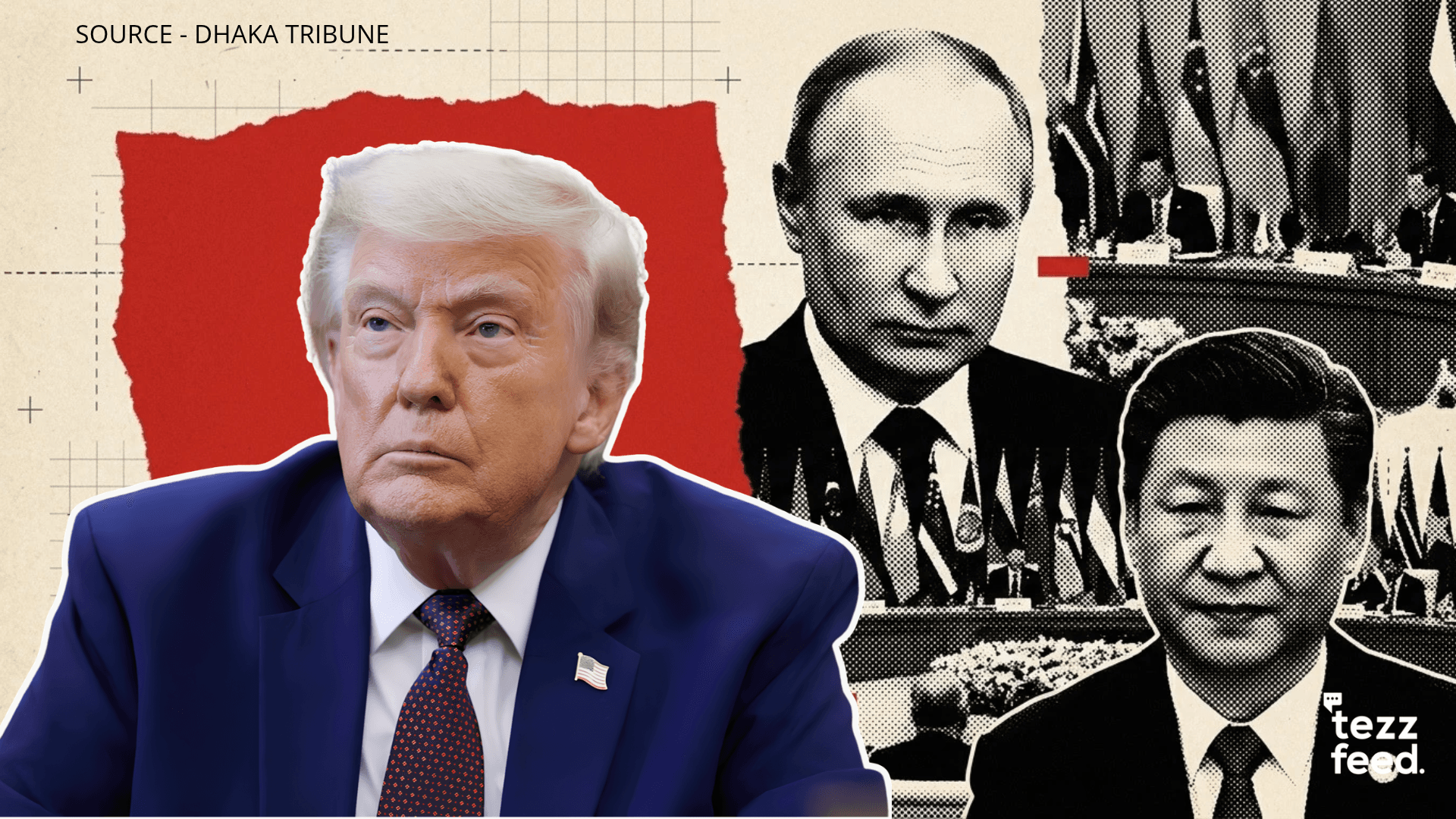
US President Donald Trump has indicated that he expects to hold a trilateral meeting with Russian President Vladimir Putin and Chinese President Xi Jinping during the upcoming Asia-Pacific Economic Cooperation (APEC) leaders' summit in China.
Speaking to reporters on Sunday, November 8, before departing Florida for Washington, Trump said he would travel to China for the summit and expected one of his meetings to involve both the Russian and Chinese leaders.
"One of the meetings, I think, will be with President Putin and President Xi, and that'll be interesting," Trump said. He added that the discussions would cover several international issues, particularly denuclearization and efforts to end the ongoing war involving Iran.
"We're talking about a lot of things, including denuclearization, but we'll be talking about a lot of things. We're trying to end the war in Iran," he told reporters.
The proposed meeting could bring together three of the world's most influential leaders at a time of heightened international tensions, with conflicts in the Middle East and Ukraine, nuclear security, and relations among major powers dominating diplomatic discussions.
The APEC summit is scheduled for November 18–19.
The APEC leaders' summit is scheduled to take place on November 18 and 19 in Shenzhen, the southern Chinese technology and business hub. China is hosting this year's summit, which brings together leaders and representatives from 21 Asia-Pacific economies, including the United States, China, and Russia.
Trump's proposed visit is expected to include bilateral diplomatic engagements alongside discussions involving other international leaders. Although Trump expressed confidence that he would meet Putin and Xi, he did not provide a confirmed schedule or specify whether the three leaders would participate in a formal trilateral session. If it takes place, the meeting would mark a significant diplomatic development, bringing the leaders of the United States, Russia, and China together for discussions on several major global challenges.
The Iran war could dominate discussions.
One of the central issues Trump identified for the proposed meeting is the ongoing war involving Iran. The US president said Washington was working to bring the conflict to an end, suggesting that discussions with Moscow and Beijing could form part of broader diplomatic efforts.
Russia and China maintain significant political, economic, and strategic relationships with Tehran. Both countries have opposed aspects of Western policy towards Iran, making their involvement potentially important in any wider diplomatic effort.
However, the three governments have different interests and strategic priorities in the Middle East. It remains unclear what specific proposals, if any, could emerge from discussions involving the three leaders. Trump did not disclose details of a possible peace framework or explain what role he expects Putin and Xi to play in ending the conflict.
Denuclearization and nuclear arms control on the agenda
Trump also highlighted denuclearization as another major subject for discussion with Putin and Xi. The US president had previously expressed interest in holding three-way arms-control talks with the Russian and Chinese leaders, arguing that the three countries should explore ways to reduce nuclear threats. The proposed discussions come amid concerns about global nuclear competition, the future of arms-control agreements, and the strategic modernization of nuclear arsenals by major powers. Washington has long sought to maintain strategic stability with Moscow while addressing China's expanding military capabilities.
A meeting involving all three leaders could provide an opportunity to discuss transparency, nuclear risk reduction, and potential limits on weapons development. However, no specific agreement or negotiating framework has been announced.
Putin reportedly wants to discuss the Ukraine war.
The proposed trilateral meeting could also involve discussions about Russia's war in Ukraine. Putin has proposed using a meeting with Trump and Xi to discuss ending the conflict, which began with Russia's full-scale invasion of Ukraine in February 2022. Moscow is reportedly interested in discussing a possible settlement that would reflect its strategic objectives. Trump has also suggested that negotiations to end the Russia-Ukraine war could be approaching an agreement.
In an interview with CBS's 60 Minutes, he said, "I believe we're very close to making a deal."
However, he offered few details about the potential agreement, saying it could leave Ukraine in a "little bit different shape."
The comments have raised questions about the possible terms of a settlement, particularly concerning Ukraine's territorial integrity and the involvement of Kyiv in any negotiations. Neither a concrete agreement nor a confirmed agenda for Ukraine-related discussions at the proposed trilateral meeting has been announced.
A potentially significant diplomatic encounter
The prospect of Trump, Putin, and Xi sitting together has attracted international attention because of the political and strategic influence each leader represents. For Washington, discussions with Moscow and Beijing could provide an opportunity to address nuclear security and conflicts that have complicated US foreign policy. For Russia, a meeting with the American and Chinese presidents could also carry diplomatic significance amid continuing tensions with Western governments. China, meanwhile, has maintained that international disputes should be resolved through dialogue and diplomacy while seeking to protect its own strategic and economic interests.
Nevertheless, bringing the three leaders together does not necessarily guarantee progress on the issues under discussion. Their governments have competing priorities on Iran, Ukraine, nuclear weapons, and international security.
For now, Trump's announcement signals an intention to pursue high-level diplomatic engagement during the Shenzhen summit. Whether the proposed meeting produces concrete agreements or simply opens the door to further negotiations remains to be seen.