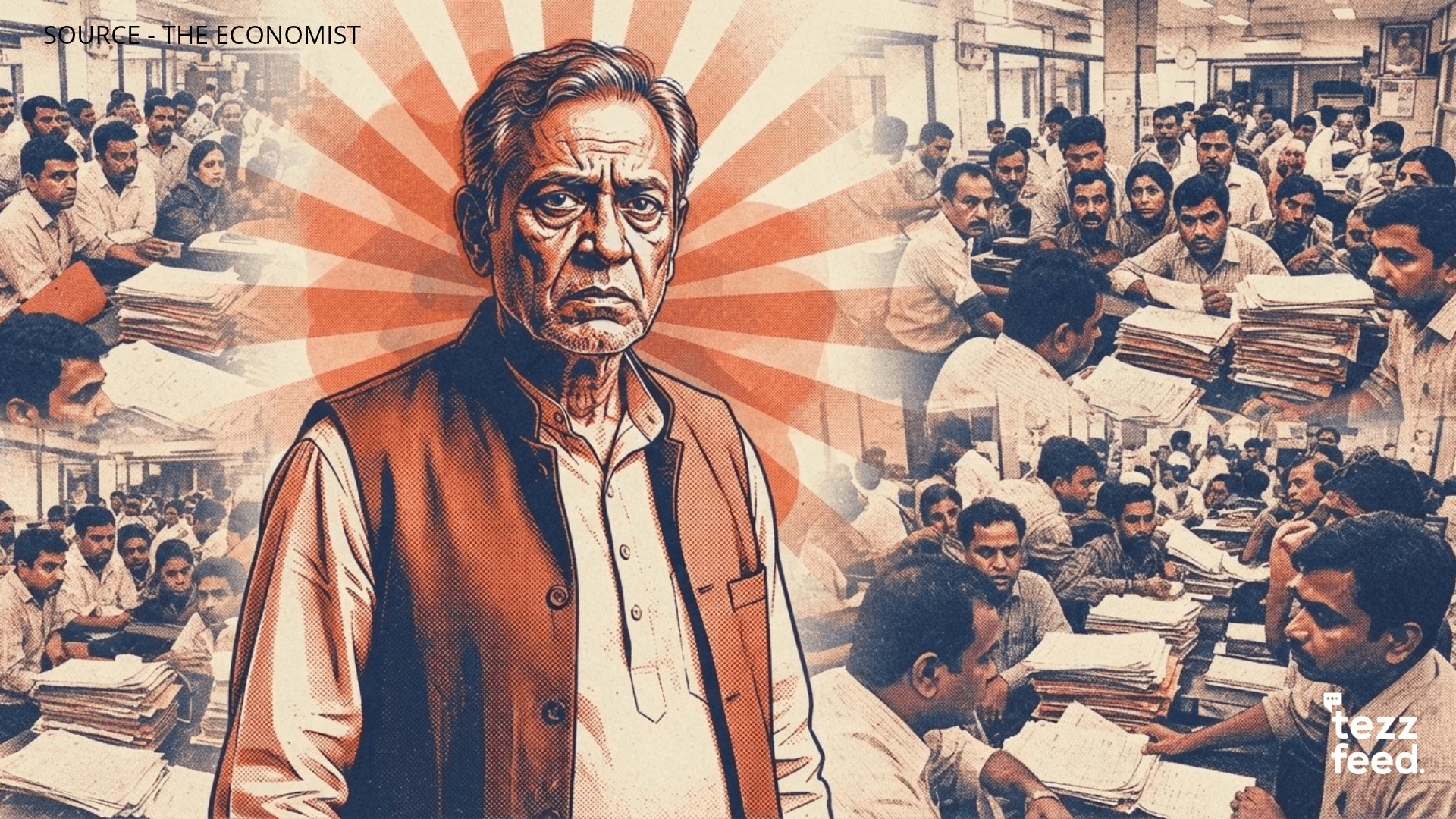
Bangladesh’s banking sector is facing a deepening financial crisis, with widespread corruption, massive loan defaults, and capital shortages pushing several financial institutions towards insolvency, according to a report by British magazine The Economist.
The report highlights how years of financial irregularities and loan-related corruption during former Prime Minister Sheikh Hasina’s 15-year rule severely weakened the country’s banking system, leaving it struggling to recover following the fall of her government in 2024.
One of the most alarming indicators is the sharp rise in non-performing loans (NPLs), which now account for around one-third of all outstanding loans in the banking sector. The figure is significantly higher than the corresponding rates in neighboring countries, standing at 1.7% in India and 5% in Pakistan. The banking sector’s capital-to-risk-weighted assets ratio has also fallen to negative 3.8%, reflecting the extent to which accumulated losses have eroded banks’ ability to absorb financial shocks. The crisis is increasingly affecting ordinary depositors. Customers of several troubled banks have reportedly faced difficulties withdrawing their savings, with some waiting months without being able to access their money. Liquidity shortages have further weakened public confidence in financial institutions.
The report also points to alleged large-scale financial looting and politically connected lending as major contributors to the sector’s deterioration. Loans extended to politically influential business groups and borrowers who eventually failed to repay have left banks burdened with enormous amounts of defaulted debt.
The problem is particularly serious for some state-owned and Islamic banks, where poor governance, irregular lending practices, and concentrated exposure to large borrowers have contributed to financial instability. The consequences extend beyond the banking industry. Weak banks are becoming less capable of financing businesses, while growing uncertainty is discouraging investment and putting additional pressure on economic activity. Businesses that depend heavily on bank loans may face tighter credit conditions, potentially affecting industrial production, employment, and overall economic growth.
However, the scale of the crisis is not uniform across all institutions. Bangladesh Bank data reported in November 2026 show that 15 banks account for more than 85% of the sector's non-performing loans, indicating that financial distress is particularly concentrated among a group of troubled lenders.
Economists and financial analysts argue that restoring confidence will require more than emergency liquidity support. Recovering defaulted loans, holding those responsible for financial irregularities accountable, strengthening regulatory oversight and ensuring transparency in bank management will be essential.
The government and Bangladesh Bank also face the difficult task of recapitalizing struggling institutions while protecting depositors and maintaining financial stability. Such measures could require substantial public resources at a time when the economy is already facing significant fiscal and investment challenges.
Bangladesh's banking crisis therefore represents more than a problem within financial institutions. It is a broader economic challenge that threatens public confidence, private investment, and the country's long-term development prospects. Rebuilding trust in the banking system will depend on meaningful reforms, accountability, and effective action against financial misconduct.