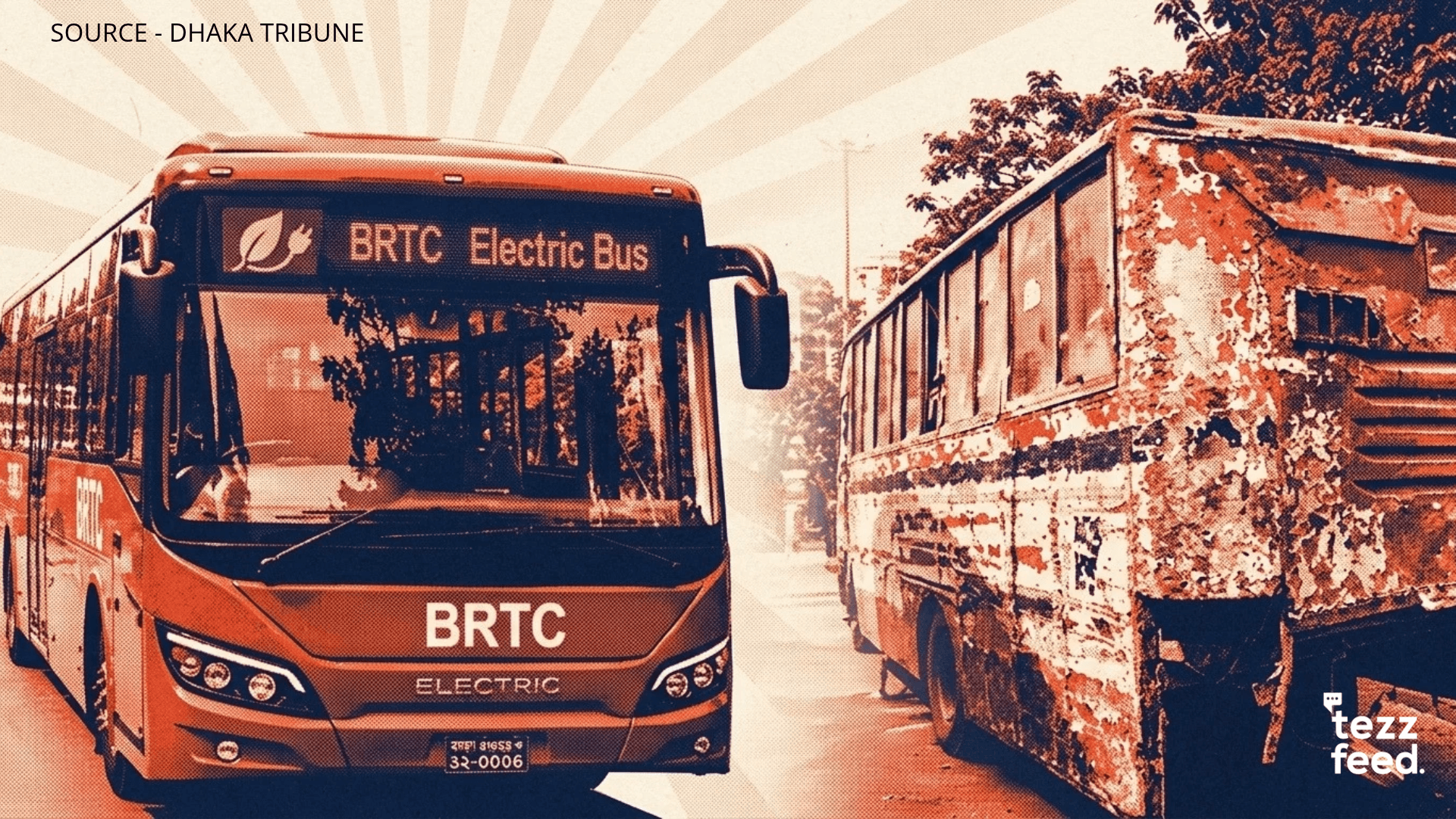
The government is planning a major transformation of Dhaka's public transport system, with 3,000 modern electric buses set to be introduced in phases to improve passenger services, reduce air pollution and bring greater discipline to the capital's congested roads.
Road Transport, Railways and Shipping Minister Sheikh Rabiul Alam said the initiative would initially be launched under the Bangladesh Road Transport Corporation (BRTC), with private bus operators gradually brought into the new arrangement.
The rollout will not happen overnight. A ministry official said the buses would arrive in batches of 100 to 200 rather than being delivered all at once, allowing the authorities to introduce the new system gradually.
The announcement was made at a meeting on public transport reform and implementation of the gross-cost model under the World Bank-supported Bangladesh Clean Air Project (BCAP), held at the Road Transport and Bridges Ministry on Tuesday.
One of the most significant changes under the proposed reform is the replacement of the traditional route-permit-based operating arrangement with a system of three-party agreements. Under the proposed model, agreements will be signed among the Dhaka Transport Coordination Authority (DTCA), bus operators and vehicle suppliers. The arrangement is intended to establish clearer responsibilities for bus procurement, fleet management, service delivery and operational standards.
Instead of allowing individual operators to compete independently for passengers on the same routes, the government wants to introduce a more coordinated system in which designated operators will run services according to approved schedules and standards. The reform is also expected to make transport companies more accountable for vehicle maintenance, passenger safety and service quality.
The proposed system will introduce a different financial arrangement for bus operators. Under the gross-cost model, passenger fares will be collected by the designated authority rather than retained directly by individual bus operators. Operators will then receive payments at a fixed rate per kilometre for running their buses, subject to compliance with prescribed service standards.
This represents a major departure from the existing arrangement, in which operators' earnings are closely linked to the number of passengers they can attract. The government expects the new payment structure to reduce unhealthy competition for passengers, discourage reckless driving and encourage adherence to designated routes and schedules. It could also make revenue collection more transparent and improve accountability across the public transport network.
The government has decided to begin the initiative through BRTC before gradually expanding participation to private transport operators. The state-owned transport corporation will play an important role in introducing the new operating structure and demonstrating how the system can function. The phased approach is intended to allow authorities to address operational challenges before expanding the programme across a wider network. The ministry official's indication that buses will arrive in batches of 100 to 200 also suggests that infrastructure development, vehicle procurement and operational preparations will proceed alongside the rollout. The full transformation is expected to take around two to three years, with support from the World Bank.
Dhaka's public transport system has long struggled with fragmented ownership, overlapping routes, irregular schedules and intense competition among bus operators. According to DTCA figures cited in recent reporting, although 418 bus routes have been approved in the capital, only 98 are currently operational. Around 7,000 to 7,500 buses carry an estimated 3.7 million to 3.8 million passengers every day. The proposed reform seeks to address these structural problems rather than simply increase the number of vehicles on the road. The government believes that organised route management, designated operators and standardised services could make daily commuting more predictable and comfortable.
The introduction of electric buses is also an important part of the government's environmental agenda. Dhaka regularly experiences severe air pollution, with transport emissions contributing to the city's overall pollution burden. Replacing conventional fuel-powered buses with electric vehicles could help reduce roadside emissions and noise pollution, particularly along heavily travelled urban corridors. However, the success of the initiative will depend on more than the arrival of new buses. Charging stations, maintenance depots, spare-parts supply chains and trained technical personnel will be essential.
Despite the scale of the announcement, several practical questions remain. The government will need to clarify procurement arrangements, financing, the selection of private operators, route allocation and the responsibilities of the participating companies. Existing bus owners and workers will also need to be integrated into the new system to avoid disruption to livelihoods and passenger services. Equally important will be the development of an effective monitoring mechanism to ensure that operators receive payments according to actual service delivery and that passengers receive the promised improvements. Without proper enforcement, the new contractual arrangement could face many of the same operational difficulties that have affected previous transport reform initiatives.
The planned introduction of 3,000 electric buses represents an ambitious attempt to reshape how public transport operates in Dhaka. By beginning with BRTC, bringing in buses in manageable batches and replacing fragmented route-based operations with contractual arrangements, the government is seeking to establish a more coordinated transport network. For millions of daily commuters, the real measure of success will not simply be the number of electric buses introduced. It will be whether waiting times decrease, buses follow schedules, passenger safety improves and journeys become more comfortable and affordable.
If implemented effectively, the reform could mark a significant shift in Dhaka's public transport system. But its success will ultimately depend on sustained investment, transparent contracts, strong institutional oversight and consistent enforcement.